|
Getting your Trinity Audio player ready…
|
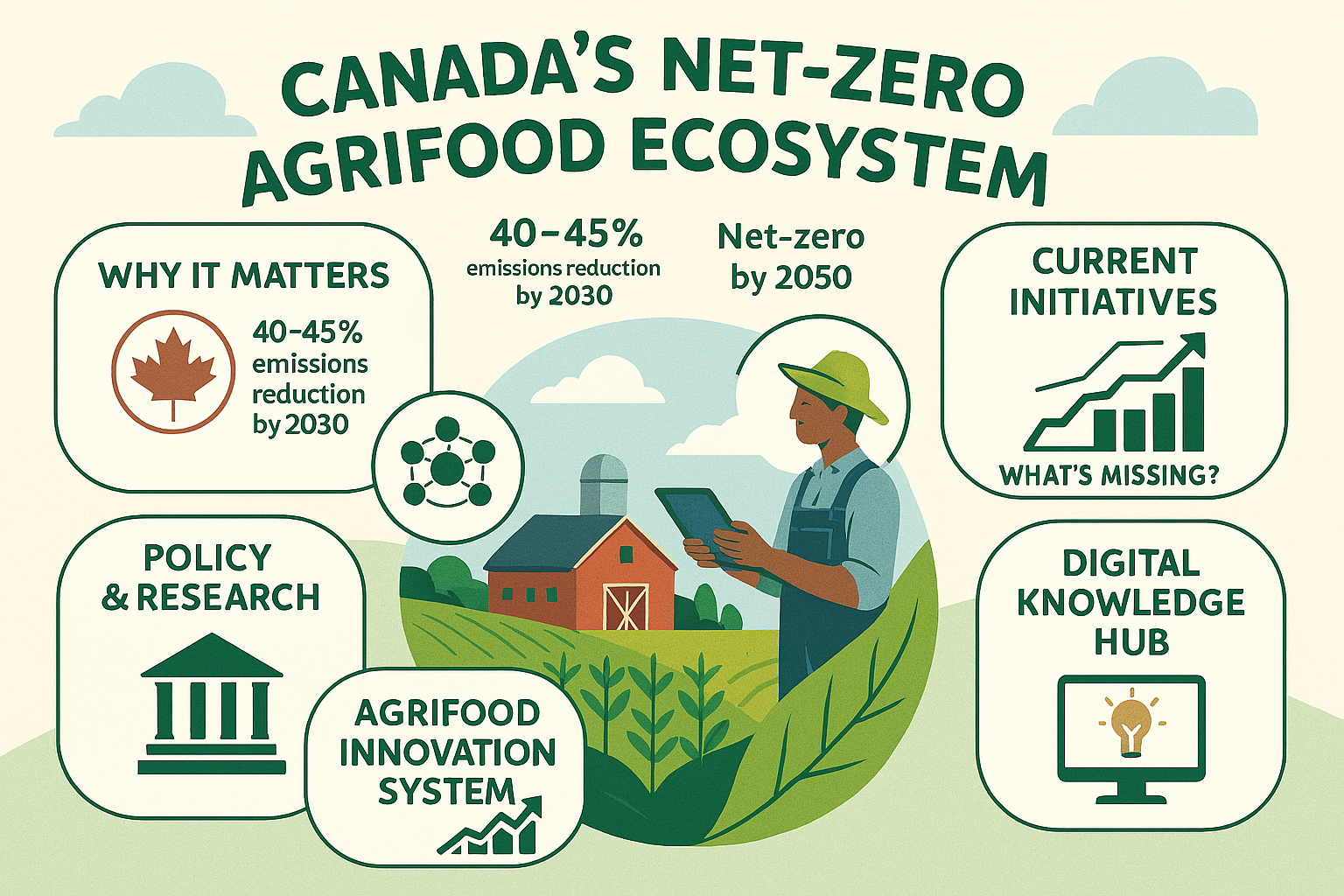
Why This Matters
Canada’s agriculture sector is at a critical juncture. It’s not just about growing food anymore – it’s about feeding a growing population, supporting livelihoods, and fighting climate change all at once. Agriculture is unique because it is:
- Part of the problem (emits greenhouse gases)
- A victim of the problem (climate change threatens crops and livelihoods)
- A big part of the solution (can sequester carbon, adopt sustainable practices)
The stakes are high: agriculture accounts for 10% of Canada’s total emissions, and the government has set ambitious targets: reduce emissions by 40–45% by 2030 and hit net-zero by 2050. This means business as usual won’t cut it. We need transformative change, not tweaks.
The Big Picture
Canada is already moving in the right direction with initiatives like:
- Sustainable Agriculture Strategy (SAS) and Sustainable Canadian Agriculture Partnership (SCAP),
- Commitments to cut fertilizer emissions by 30% by 2030
- Support for the Global Methane Pledge
- Living Laboratories Initiative – farmers, scientists, and civil society co-developing climate-smart solutions
But here’s the catch: improving current systems isn’t enough. We need innovation, collaboration, and knowledge-sharing at scale. Think of agriculture as a complex combination of social and ecological systems, not just a simple matter of growing things. Social, cultural, and behavioural factors matter just as much as the science of cultivation.
What’s Missing?
Despite progress, there’s a knowledge gap – especially in understanding the human side of adopting environmentally sound technologies and farming practices. For instance, why do farmers hesitate to adopt sustainable practices? What social, economic, and cultural barriers exist? Few social scientists are studying these issues in agriculture, and that’s a problem.
Enter what I will call Agrifood Innovation Systems for a Net-Zero Future: a comprehensive lens through which to view Canada’s pursuit of environmentally sustainable agriculture as a requiring collective ecosystem of researchers, farmers, industry, and policymakers to tackle these questions head-on.
Action Plan for Government & Industry
Here’s what needs to happen – practical, doable steps:
1. Build a Nationwide Knowledge Network
- Create a collaborative ecosystem linking universities, colleges, industry, non-profits, Indigenous groups, and government.
- Focus on leveraging frameworks and methodologies to understand the broader psycho-social elements of adoption barriers and thus design more comprehensive and effective incentives.
2. Map the Barriers
- Conduct comprehensive surveys to identify economic, social, and policy constraints.
- Build a national database of indicators that track adoption trends, benchmark progress, and inform policy.
3. Learn from the Best
- Study international models of agri-innovation and governance.
- Adapt global best practices to Canada’s unique context.
4. Make Policy Smarter
- Develop evidence-based recommendations that consider cultural, ethical, and economic realities to complement the technological gadgets.
- Position the knowledge network to work closely with federal and provincial agriculture departments and regional-municipal agrifood initiatives to ensure research feeds directly into policies, programs and practices.
5. Train and Equip the Farmers
- Rather than preaching at farmers about environmental stewardship, launch micro-credential programs that teach agribusinesses and farm workers the economic and ecological benefits of sustainable practices.
- Create internship programs in the knowledge network to train students as the next generation of agri-innovation leaders. That way, Canada can strategically build a steady supply of expertise for the present and future.
6. Mobilize Knowledge Like Never Before
To prevent the knowledge network from becoming a mere academic enterprise,
- Create a user-friendly digital platform housing:
- Research findings
- Best practices
- Curated literature
- A directory of experts and advisory organizations
- Pursue robust engagement with farmers, industry and the public by working closely in joint outreach workshops, webinars with intermediary organizations such as Canadian Agri-Food Automation and Intelligence Network (CAAIN), Global Institute for Food Security (GIFS), and Protein Industries Canada (PIC).
Why This Will Work
- It’s inclusive: covers all provinces and territories, all farm types, sizes, and ownership models.
- It’s interdisciplinary: blends tech innovation with social science insights.
- It’s policy-connected: works hand-in-hand with federal, provincial and municipal initiatives and aligns with the federal government’s climate goals.
What’s in It for You?
For government leaders:
- Achieve climate targets faster.
- Strengthen Canada’s global reputation in sustainable agriculture.
- Build resilient rural economies.
For industry leaders:
- Stay competitive internationally by deploying the latest technologies and practices.
- Reduce risk from climate impacts.
- Access cutting-edge research and training.
For farmers:
- Practical tools and training.
- Policies that reflect real-world challenges.
- Rather than being preached at by environmental sustainability evangelists, you will have a voice in shaping and co-creating Canada’s agri-future.
Bottom Line
Canada’s agriculture sector can be a climate hero, but only if we act boldly and collaboratively. A Nationwide Knowledge Network is the blueprint for that transformation, bringing together Canada’s highly fragmented agriculture sector and connecting people, ideas, and action to make sustainable farming the norm, not the exception.
Let’s make Canada the global leader in eco-agriculture.